|
|
|
|
|
|
|
|
|
|
|
|
|
|
|
 |
||
| Size: City area of over 6300 square km. Population: 16 million Summer: Hot - averages between 25C and 30C Winter: 12C to -2C |
||||
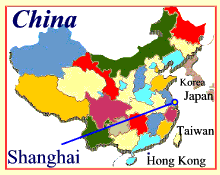
 Orientation of Shanghai Orientation of Shanghai |
||
|
Situated on the banks of Huang-pu |
||
|
|
 |
|
| History |
|||
1) AD 960 to 1280 - Song Dynasty |
|||
| First recorded settlement in this area. |
|||
2) 1280 to 1368 - Yuan Dynasty  |
|||
| Gradually developed. |
|||
| 3) 17th to 18th century |
|||
| An important Cotton processing center. |
|||
4) 1842 - Ching Dynasty  |
|||
|
After the Treaty of Nan-Jing, some area of Shanghai ceded to British, followed by American and European, forming the "foreign Concessions", all having their own laws, police, trading companies and banks within their designated boundaries, without intervention by the Ching Government. |
|||
| 5) 1937 to 1945 - Sino-Japanese War |
|||
| Shanghai was occupied by the invaders. |
|||
| 6) After 1945 |
|||
| Civil war broke out between the Nationalists and Communists. |
|||
| 7) 1949 |
|||
|
Peoples Republic of China united the whole country, took over control and all private property and businesses was brought under state control. |
|||
|
|
| Welcome to Shanghai by Mr. R. Dibbs |
||
|
One's first impression of Shanghai is of a modern, vibrant, wealthy, international city. The many new hotel and office buildings contrast with the streets of old buildings housing restaurants, teahouses, shops and private residences. Perhaps the most striking impression is that, because of the speed of development, one will be greeted by new views. |
||
|
|
 |
|
| Metro Map |
|||
 |
Metro stations Interchange Ia Shanghai Railway Station Ib Ren-mum-kwong-cheung Ic Chung-shan-kung-yuen Railway R1 Shanghai Railway Station  R2 Shanghai South Railway Station  Airport 1 Pu-dung Airport  2 Hung-kiu Airport  MT Magnetic Train to Airport 1 |
||
| Metro Stations Interchange |
||||||
| Ia | Shanghai Railway Station |
Ia |
Shanghai Railway Station | |
||
| Ib | Ren-mum-kwong-cheung |
Ib |
Ren-mum-kwong-cheung |  |
||
| Ic | Chung-shan-kung-yuen |
Ic |
Chung-shan-kung-yuen |  |
||

|
||

|
||
 |
||
|
|
| City Map |
|||
 |
Metro (see metro-map) Line 1 Line 2 Pearl Line Railway R1 Shanghai Railway Station R2 Shanghai South Railway Station Airport 1 Pu-dung Airport 2 Hung-kiu Airport A to G Places of interests 1 to 7 Lu (Road) |
||
| Lu (Road) |
|||
| 1 Ten-mu-dung Lu |  |
||
| 2 Chung-shan-i Lu |  |
||
| 3 Nan-jing-dung Lu |
 |
||
| 4 Yen-an-dung Lu |
 |
||
| 5 Ren-mum Lu |
 |
||
| 6 Si-chong-chung Lu |
 |
||
| 7 Jang-yue Lu |
 |
||
|
|
| Good Old Shanghai (before 1949) |
||||
|
|
|
|||
|
|
|
|||
|
|
| Excursions |
|||
1) Hang-zhou  |
|||
| 202 km, by train about two hours. |
|||
2) Su-chow  |
|||
| 84 km, 60 trains per day, one-hour journey. By coach:- From Zhong-shan Bei Lu  every 20 min, from 06:30 to 19:30, 80 minutes journey. |
|||
3) Nan-jing  |
|||
| 303km, by train about 3.5 to 4 hours. |
|||
4) Wu-sack  |
|||
| 128km, by train about one and half hours. |
|||
| Note:- Get detailed information from the Hotel |
|||
|
|
| Airports |
|||
1) Pu-dong Airport  |
|||
|
Situated on the south-eastern side of Shanghai, 55km from the City center, 45 to 60 minutes by air-port shuttle to the Center. |
|||
2) Hung-kiu Airport  |
|||
|
Located on the eastern side of the city, 12 km to the city-center, 6km to the no 2 metro line Chiu-ja-wei |
|||
| Accommodation |
|||
|
Accommodation can be booked via Travel Agents in Hong Kong or in Shanghai. |
|||
|
|
|
|










 )
) and 27km from the outlet of Yang-tze River.
  The river is about 200 yards wide, 27 feet deep and is navigable all year round.



 (take taxi to this station)